The pilot always works. Fifty devices on a bench, a dashboard that updates, a demo that gets the next round of budget approved. Then the fleet ships, the devices meet real networks and real power supplies, and a completely different set of problems shows up.
I've watched this happen to teams who were genuinely good. The pilot was never the hard part. What follows is the list of things we plan for before the pilot ends, roughly in the order they bite.
Device identity is a supply-chain problem
Every device needs a unique identity that cannot be cloned and that your platform can revoke. In the pilot it was a hard-coded API key in the firmware, and that was fine, for the pilot. In the fleet:
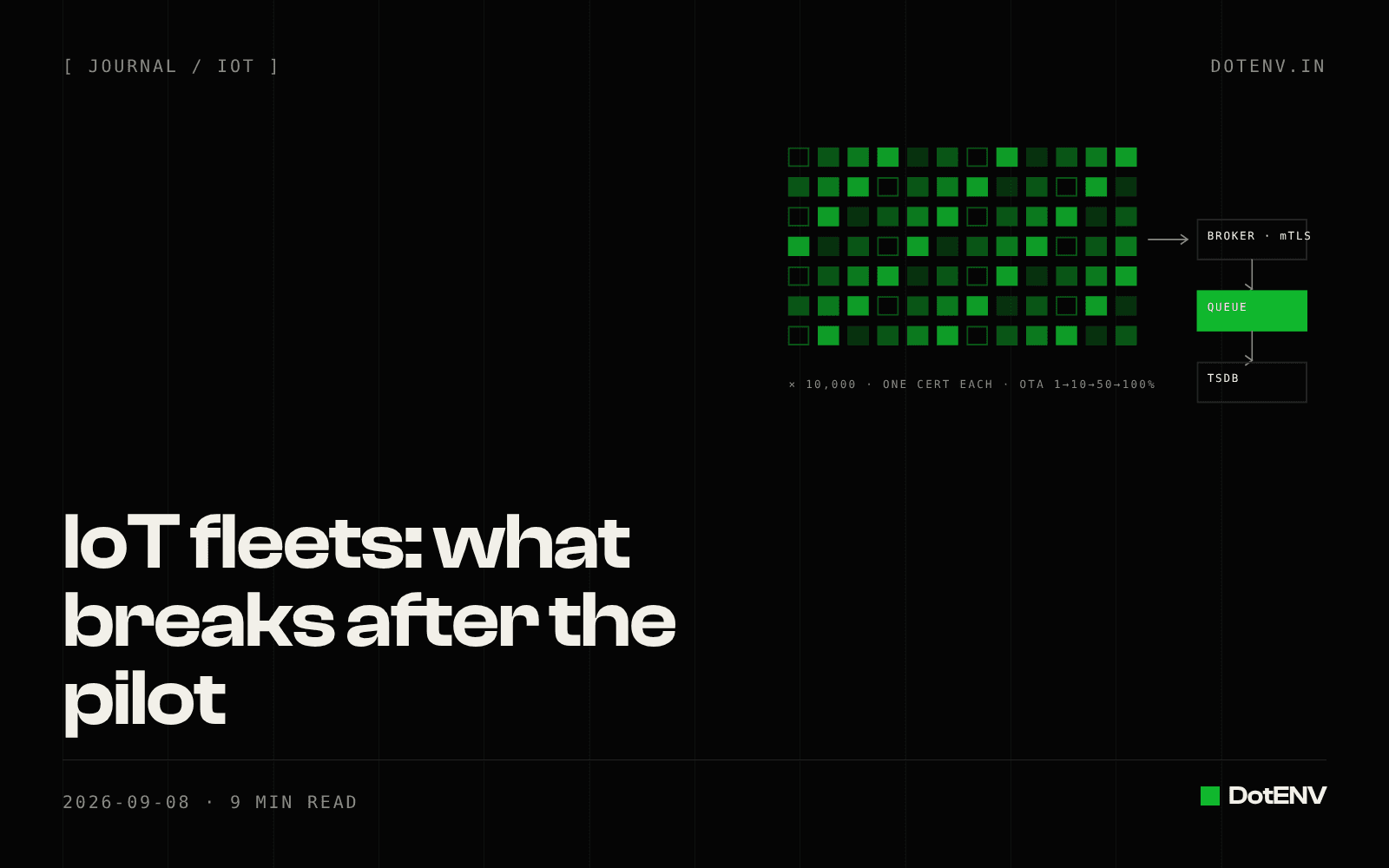
- A per-device certificate, provisioned at manufacture or on first boot through a secure element. Never a shared secret in firmware.
- Mutual TLS to the broker, so the platform knows which device it is talking to and the device knows it is talking to you.
- A revocation path that works in minutes, because a stolen device on a public network is not hypothetical.
Retrofitting identity onto a fleet that has already shipped means a truck roll. Design it in.
Over-the-air updates are the product
A fleet you cannot update is a liability with a battery. We treat the update system as the first feature, not the last.
- A/B partitions so a failed update rolls back by itself. A device that bricks in a field you cannot reach is gone.
- Staged rollouts: one percent, ten, fifty, a hundred, with an automatic halt on any rise in crash reports or offline rate.
- Signed images, verified on the device before they are written, with a key you can rotate.
- Delta updates where bandwidth is metered. A forty-megabyte image over a 2G modem is a week, if it finishes at all.
Telemetry has backpressure whether you planned it or not
Ten thousand devices each sending a reading every second is ten thousand messages a second on a good day. After an outage it's a thundering herd: every device reconnects at once and uploads its backlog, and whatever is behind the broker falls over.
- No jitter
- Jittered reconnect
| Period | No jitter | Jittered reconnect |
|---|---|---|
| t-2 | 10k/s | 10k/s |
| t-1 | 10k/s | 10k/s |
| outage | 0k/s | 0k/s |
| Row 4 | 0k/s | 0k/s |
| t+1 | 95k/s | 22k/s |
| t+2 | 60k/s | 28k/s |
| t+3 | 30k/s | 26k/s |
| t+4 | 15k/s | 20k/s |
| t+5 | 10k/s | 15k/s |
| t+6 | 10k/s | 12k/s |
| t+7 | 10k/s | 10k/s |
| t+8 | 10k/s | 10k/s |
- Buffer on the device with a bounded queue and a policy: drop oldest, downsample, or hold. Decide per metric, because they are not all equal.
- Jitter the reconnect.
- Put a queue (Kafka or equivalent) between the broker and anything that writes to a database. The database should never be the thing that says no to a device.
- Design the payload for the worst link, not the office Wi-Fi: binary encoding, batching, compression.
Time-series storage is its own discipline
The pilot wrote readings into Postgres. By ten thousand devices that table is the largest thing in the company and every query is slow, including the one on the dashboard the CEO looks at.
- A purpose-built time-series store (TimescaleDB, ClickHouse, InfluxDB) with retention policies: raw for days, minute aggregates for months, hourly forever.
- Downsampling as a pipeline step, not a cron job someone remembers.
- Queries always bounded by device and time. An unbounded query on fleet telemetry is an outage with a nicer name.
Offline is the normal state
Devices lose connectivity. Vans go through tunnels, factories have dead zones, SIM cards expire on a Sunday. The device must keep doing its job and tell the story when it returns.
- Local decisions for anything safety- or revenue-critical. The cloud is advisory.
- Timestamps from a clock the device trusts, with drift correction on reconnect, so the backlog lands in the right order.
- A visible "last seen" per device on the dashboard, because "online" and "healthy" are not the same thing.
The dashboard nobody uses
Pilot dashboards show everything. Fleet operators need three views and will ignore the rest:
- What is wrong right now. Devices offline past their expected interval, error rates, failed updates.
- What changed. Rollout progress, firmware versions in the field, configuration drift.
- One device. Everything about it, for the support call.
Everything else is a report, not a screen.
Before the pilot ends
The short list we insist on seeing before anyone orders ten thousand units:
- Per-device identity and revocation, tested by revoking one.
- A signed OTA with rollback, tested by shipping a deliberately broken image.
- A reconnect storm, simulated by cutting the broker for ten minutes.
- A retention policy and a query that stays fast at projected volume.
- An offline week, simulated by unplugging a device and reading its backlog.
Each of those is a day of work on the bench and a month of work in the field. The fleet that passes them is boring to operate, which is the only kind worth owning. If you're between the pilot and the order, this is the review we run.