The most valuable businesses we work with don't have a tech team. They have a warehouse, a trading floor, a clinic, a fleet of trucks or a factory, and they run on a mix of paper, WhatsApp groups, phone calls and a spreadsheet somebody built in 2017 that nobody dares to touch.
They also have a problem that is very easy to misdiagnose. The obvious prescription, "build them an app", usually fails. Not because the app is bad. It fails because the app encodes how someone thinks the business works, and the business keeps running the way it actually works, around the app. Six months later there's a login nobody uses and a WhatsApp group that's busier than ever.
This is the method we use instead. It's slower for the first two weeks and much faster after that.
Weeks one and two: map the work, not the org chart
We sit with the people doing the work. Not the owner, not the manager. The person who receives the delivery, the clerk who raises the invoice, the dispatcher on the phone at seven in the morning.
For each workflow we write down five things:
- The trigger. What starts it? A call, a WhatsApp message, a truck arriving at the gate.
- The handoffs. Who touches it next, and how do they find out?
- The records. Which notebook, group chat or sheet holds the truth, and which ones hold a copy?
- The exceptions. What happens when the stock count is wrong, the customer disputes the bill, the driver is sick? Exceptions are where the real process lives.
- The time. Minutes per instance, instances per week. This becomes the first number on the scoreboard.
By the end of two weeks we have a process map with a cost on every bottleneck, in hours per week. Usually three or four workflows account for most of it, and they are rarely the ones the owner would have guessed.
Decide what not to digitise
This is the step most projects skip, and it's the one that keeps the business's trust. Some things should stay on paper or in a chat:
- Anything done fewer than a handful of times a month.
- Anything where the person doing it is the only person who ever needs the result.
- Anything that changes shape every time: a negotiation, a site inspection with no two alike.
Digitising those adds friction and removes nothing. Leave them alone, and write that decision down so nobody re-litigates it in a quarter.
Digitise the record, then the handoff, then the decision
In that order, and only as far as each step earns its keep.
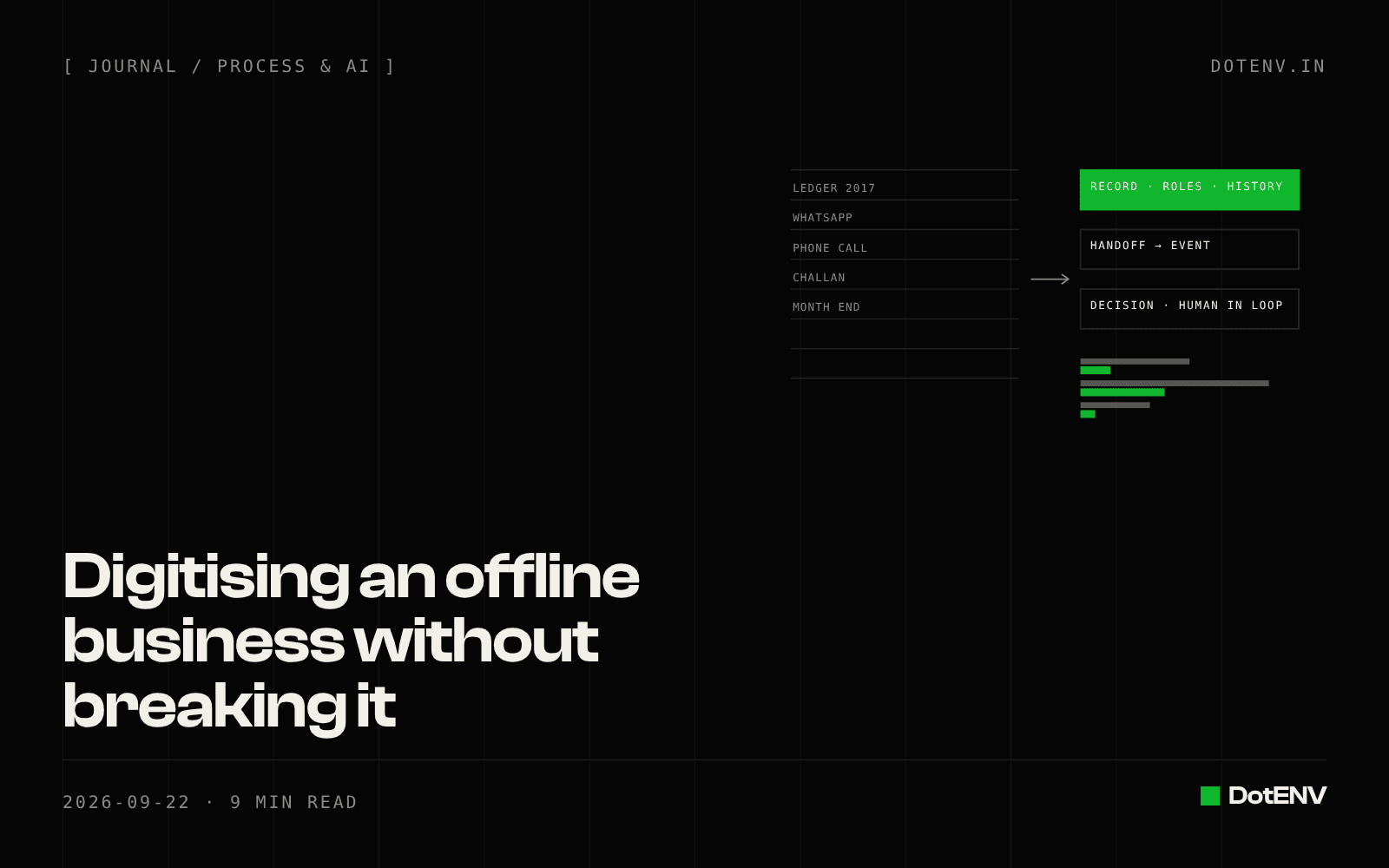
The record. The ledger, the stock count, the customer list becomes a structured system with roles, history and a search box. Often this alone recovers a third of the hours, because people stop reconciling copies of the same thing.
The handoff. The WhatsApp message that says "truck 4 is loaded" becomes an event that updates the record and notifies the next person. The group chat does not disappear. It just stops being the system of record, which is the only thing that was wrong with it.
The decision. Only now is there enough clean data to put AI on anything. Reorder points from real consumption. Invoice fields extracted from supplier PDFs. Support messages classified and drafted for a human to approve. Each model is scoped to one decision, evaluated against the humans doing it today, and switched on with a human in the loop until the numbers say otherwise.
Where AI actually pays
From the engagements we've run, the models that pay for themselves inside a quarter are boring, and I mean that as the highest compliment.
- Document extraction. Invoices, delivery challans, lab reports, forms. Hours of typing become minutes of checking.
- Classification and routing. Which team, which priority, which category. Removes the person whose whole job was forwarding.
- Forecasting on your own history. Demand, cash, staffing. Not better than a good analyst. Much better than nobody, which is the usual alternative.
- Drafting, not sending. Replies, quotes, reminders drafted by a model and sent by a person. The person gets faster; the customer still hears from a human.
The ones that don't pay: chatbots answering questions nobody asked, dashboards nobody opens, and "AI strategy" decks.
- Before
- After digitising + AI
| Item | Before | After digitising + AI |
|---|---|---|
| Invoice handling | 22h | 6h |
| Customer support | 38h | 17h |
| Inventory reconciliation | 14h | 3h |
| Reporting | 10h | 2h |
Measure like your finance team would
Every month, three numbers per workflow, in a form the owner and the accountant both accept:
- Hours
- returned to the team, against the week-one baseline
- Cost
- removed, including the software itself
- Revenue
- added that would not have happened
If a change doesn't move one of those numbers in three months, we roll it back. That rule is the reason the method keeps the business's trust, and it's the rule we are most often asked to drop. We don't.
What "without breaking it" actually means
- Nothing goes live on a Monday or before a month end.
- Every new system runs alongside the old one for at least one full cycle.
- The people who did the work on paper are the ones who sign off that the software does it right.
- Training is one page per role, in the language the floor speaks, with screenshots.
A business that has run for twenty years on paper is not behind. It's a working system with twenty years of edge cases built in. The job is to learn those before touching anything, and then to touch only what pays. If that sounds like your business, the two-week audit is where we'd start.