The first enterprise customer sends a three-hundred-question security questionnaire. The first government tender asks for an ISO 27001 certificate. The first health-tech partner wants a HIPAA business associate agreement. The founder forwards all of it to engineering with a one-line email: "how hard is this?"
The honest answer depends entirely on what was built in from the start. Teams that treated security as a sprint for later are looking at a rebuild. Teams that built to a baseline are looking at a few weeks of evidence collection. The baseline is not large. This is it.
The insight: controls are engineering tasks
Read any framework's control list and translate it into plain engineering:
| The control says | The engineering task is |
|---|---|
| Logical access is restricted to authorised users | SSO, roles in code, no shared accounts |
| Changes are authorised, tested and approved | Protected main branch, required review, CI gate |
| System activity is logged and monitored | Centralised structured logs, alerts, retention |
| Data is encrypted in transit and at rest | TLS everywhere, KMS-managed keys on every store |
| Vulnerabilities are identified and remediated | Dependency scanning in CI, patch SLAs |
| Incidents are responded to and reviewed | On-call, runbooks, postmortems with owners |
Every row is something a good engineering team wants anyway. Compliance is the paperwork proving you did it.
The baseline, in order of leverage
1. Identity. One identity provider for staff and systems. Roles defined in code and reviewed quarterly, with the review generated from the provider's API rather than a spreadsheet someone forgets. Service accounts with short-lived credentials. This one control answers a quarter of any questionnaire.
2. Change management from the pipeline. Main branch protected. Every change is a pull request with a reviewer who is not the author. CI runs tests, lint and a dependency scan. Deploys happen from CI, never from a laptop. The pipeline's own history becomes the change log: dated, attributed, tamper-evident, and nobody had to write it.
3. Secrets and encryption. Secrets in a manager, injected at runtime, rotated on a schedule; none in code, chat or tickets. Every datastore encrypted at rest with managed keys; every connection TLS. Write it as infrastructure code so the state is inspectable without logging into anything.
4. Logging that answers questions. Structured logs from every service, shipped to one place, with the fields an investigator needs: who, what, when, from where, on which record. Retention set by policy and enforced by the platform. Alerts on authentication anomalies, privilege changes and error spikes.
5. Vulnerability management on autopilot. Dependency updates opened automatically and merged within a window by severity: days for critical, weeks for low. Container images rebuilt on a schedule. A software bill of materials generated per release, because buyers have started asking for one.
6. Incident response that has been rehearsed. A rota, a runbook per failure class, a blameless postmortem template and a rule that postmortems ship within five working days. Then a drill, twice a year, with the results kept. The drill is the part everyone skips and the part every auditor asks about.
7. Data handling by design. A data map: what personal data you hold, where, why and for how long. Export and delete endpoints that actually work when tested. Consent recorded with purpose and time. Region-pinned storage where residency matters.
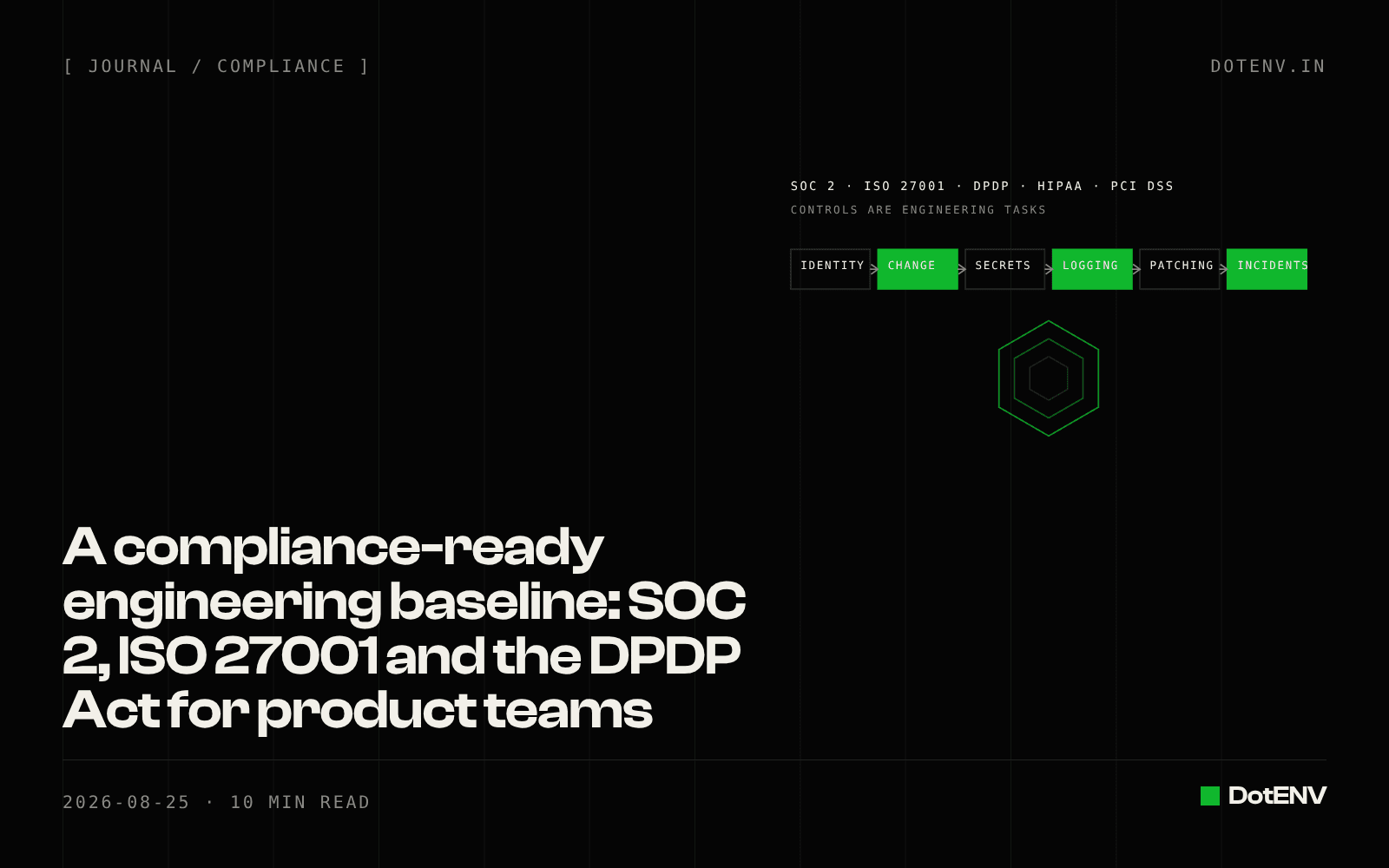
Identity
SSO · roles in code
Change
PR · review · CI gate
Secrets
manager · KMS · TLS
Logging
structured · retained
Patching
auto PRs · SLAs
Incidents
rota · drills
Framework specifics that trip teams up
SOC 2 is about proving the controls operated over a period, usually six to twelve months. The pipeline history and the access reviews are your evidence. Start collecting before the audit window opens, not during it.
ISO 27001 wants a management system: a risk register, a statement of applicability, supplier reviews, internal audits. The engineering baseline covers the technical controls; the documents around them need an owner who is not an engineer, or they won't get written.
GDPR and the DPDP Act both turn on lawful basis, purpose limitation and the rights of the person whose data it is. India's DPDP Act adds consent-manager mechanics and breach notification to the Data Protection Board. The engineering lift is the consent record and the notification path. Build the data map first; everything else follows from it.
HIPAA is narrower than it looks: safeguards for protected health information, audit trails on access, and business associate agreements with every vendor that touches it. The hard part is usually the vendor list.
PCI DSS is best handled by keeping card data out of your systems entirely. Tokenise at the edge with a payment provider and the scope you must prove shrinks to almost nothing.
+ policies, vendor reviews
+ ISMS, risk register, audits
+ consent manager, DPO
+ BAAs, training records
if card data is tokenised at the edge
| Item | Value |
|---|---|
| SOC 2 | 80% |
| ISO 27001 | 65% |
| DPDP / GDPR | 70% |
| HIPAA | 75% |
| PCI DSS | 90% |
Evidence as a by-product
The expensive way to pass an audit is a quarter of screenshots. The cheap way is a collector that pulls evidence on a schedule from the places it already exists.
- CI: runs, approvals, scan results.
- Cloud: IAM state, encryption settings, configuration.
- Identity provider: users, roles, last review.
- Ticketing: incidents, postmortems, change links.
If you're starting from zero
Do the first three items this quarter: identity, pipeline-driven change management, secrets and encryption. They are the ones a rebuild cannot fix cheaply later, and they are the ones every framework asks about first. The rest can follow the first customer who asks for it, and by then you'll be answering from evidence rather than promises.
We build every engagement to this baseline by default. If you'd like to see what it looks like in a real pipeline, the compliance page walks through it.